You know, for a long while there, 2016 was shaping up to be one of the most objectively amazing years of my life. I guess it still was. This was the year I got married. The year I gained three baby nieces (one related by blood, one related by marriage, and one related by BFF-ship). The year I won a fellowship that will enable me to finish my PhD in a mostly timely manner. The year Gilmore Girls got revived for an enjoyable, four-supersized-episode run. The year the Cubs won the World Series. Everything was coming up Martin.
This was also supposed to be the year the U.S. got its first woman president. It didn't happen -- it so dramatically didn't happen that it's still sometimes difficult to believe that we're truly living in this, The Darkest Timeline -- and the disappointment was crushing. It's still crushing. It made the entire year, in a retrospective Shyamalan-like twist, feel like a failure. Earlier this month, in an article whose content is more astute than the title makes it sound, the A.V. Club wrote that "The definitive meme of 2016 was 'fuck 2016.'" In addition to all the big, serious reasons to feel anxious right now, in a small, selfish, and petty way, I'm angry that the presidential election has managed to basically ruin 2016 for me, personally, right as I was crossing the finish line. It's now impossible to feel like this was an amazing year without attaching a big, honking asterisk to the sentiment.
Predictions of Varying Certainty for 2016:
- I'll get married to GR and we'll go on a super fun honeymoon to Puerto Rico.
- I
WILL HOLD A BABY OR SO HELP ME GOD. The first baby I ever hold will be
Megan's baby, and it will be glorious and I won't drop her. Even
further, I'll get to hold more than one baby this year.
- I will go on a run that is over eight miles long (acknowledging that my longest run to date is six miles).
- I will sustain an injury of some sort which sends me to the ER, such as a minor break or stitches. (I don't hope this happens, but I sort of feel like I'm due, given my klutziness.)
- I will publish an article in an academic journal and present at least one conference.
- I
will participate in a sport, game, and/or leisure activity I've never
tried before (e.g., snowboarding, shuffleboard, Settlers of Catan).
- GR and I will visit New York City.
How prescient I actually was:
- Success! The wedding was perfect, Puerto Rico beautiful. What I didn't predict (what no one, perhaps, could have predicted) was that our pastor would actually quote the "Mawwwiage" scene from The Princess Bride during the ceremony.
- Oh hell yes. I'm a baby-holding machine now. Come at me.
- Failure. However, thanks to the 10K GR and I ran in October, I did belatedly complete one of my predictions for 2015, which was to run a road race for the first time.
- I'm afraid I might've jinxed GR with this one. While I didn't wind up with any stitches or breaks, he suffered his first-ever bone breakage when he dropped a 45lb gym weight on his toes a few weeks ago, sending him to the Urgent Care Clinic.
- Half success. I did present at the MSA, but the article I intended to publish was instead treated to a series of rejections, so that one's still pending.
- Does running in that 10K count? If not, then failure.
- Yeesh, another failure. We did visit Denver/Breckenridge and Nashville, though, and I traveled to Pasadena for the aforementioned MSA conference.
Predictions of Varying Certainty for 2017:
- Guys, this is terrifying, but: I will defend my dissertation and earn my PhD.
- I'll go on the academic job market. I'll dislike the rigamarole, possibly intensely, but will admit that the process is enriching.
- I will finally visit London. Before I do, I will renew my passport, which has expired.
- GR and I will consider moving apartments but will ultimately decide to stay put in our current pad, despite the annoying construction happening next door.
- I'll learn to cook in a more real and grown-up way that involves finding and trying new recipes for me and GR to both enjoy, rather than cycling through the same six-ish basic meals on a continuous loop, which is what I've been doing since college.
- I'll have a real-life celebrity sighting. (Because I live in neither LA nor NYC, to date, my most brag-worthy celebrity encounter is shaking hands with George Wendt in 2005. This is the bar I need to clear.)
- I'll go rock climbing for the first time in roughly eight years. I'll have fun but will be very disappointed indeed in my noodly arms.
Thursday, December 29, 2016

Tuesday, December 6, 2016
What we save to discard and discover a brand new way
For your reading pleasure, a short list of things I incorrectly believed for an embarrassingly long time:
That Vietnam is an island. (Korea, too.)
Why did I think this?
Vietnam is, of course, attached to the main Asiatic continent (as is Korea), something that's certainly obvious to anyone who bothers to look at a world map. But I was never one to stare at world maps, and I never really paid any attention to Vietnam until we started covering the Vietnam War in my U.S. History classes. History textbooks have a habit of visually isolating the countries they're discussing on maps, highlighting the country at hand while greying out surrounding territory. (Kind of like this.) This imagery, of the visually-isolated Vietnam, festered in my brain long enough that, after a while, my default sense was that Vietnam was an island. (Same goes for Korea, thanks to the Korean War.)


How old I was when I figured out the truth?: 21
In one of my senior English classes in college, we read Tim O'Brien's Going After Cacciato, a semi-surreal book set during the Vietnam War, in which a soldier goes AWOL in an attempt to flee the war and walk all the way to Paris, forcing the rest of his squad to chase after him. Most of the book is revealed to be fanciful: the chase itself is dreamed up by the novel's narrator. In my ignorance, I assumed that the concept of "walking to Paris" was part of the novel's surreal nature. (Of course you can't walk from Vietnam to France! Vietnam is an island!) Luckily, before I had a chance to publicly embarrass myself in class, I happened to finally look up Vietnam on a map (and looked up Korea at the same time).
Scale of Embarrassment: 9 out of 10
It's bad. I'm pretty sure a friend of mine, someone I consider a good friend, was literally stationed in South Korea while I still thought this.
That the "Toyota Cruiser" was called the "Toyota Spaceship"
Why did I think this?
Sheer gullibility. During the spring of my freshman year of college, there was a boy I dated for about a month. He was nice enough on his own, but he and his friends were the kind of people who would tell harmless and pointless lies to unsuspecting people, and never bother to own up to them. Said boy drove a Toyota Cruiser. One day, I asked him what the model of his car was called. Straight faced, he told me it was called the Toyota Spaceship. I thought that was a weird name for a car, and said so. He somehow stuck to his lie, even after I pointed out that the decal on the back of the car said "Cruiser." I believed him, though, because why would someone lie about that? (In defense of my gullibility, this was also the age of the Nissan Cube and the Pontiac Aztek, so all bets were off when it came to car model names.)
How old I was when I figured out the truth?: 20
That particular lie percolated in my brain for probably about a year before I realized that I'd been the butt of a pointless joke, and that it was very unlikely that the model name for the car was actually "Spaceship." The fact that I was fooled for a year about the name of a stupid car isn't too embarrassing. The fact that, during that year, I innocently insisted to someone else that the car was called the Toyota Spaceship is a bit more embarrassing.
Scale of Embarrassment: 2 out of 10
In retrospect, it was an okay joke.
That you can't recycle paper that's crunched up in a ball.
Why did I think this?
In first or second grade, my elementary school teacher told this to our class. Our classrooms had one of those large, blue recycle bins up by the front door. We were told that it is very important to recycle, and to always recycle paper, but that recycling centers will only take paper that is still perfectly crisp and flat. (Paper folded in half was also okay.)
How old I was when I figured out the truth?: 16ish
God, it's so obvious now. My teacher didn't want any punk second graders throwing paper balls into the trash or recycling bins from 20 feet away. Instead of trying to enforce that as a rule, she just told us that balled-up paper couldn't be recycled, thus placing the burden on our own, tiny consciences. It's so deviously brilliant! I don't remember when I put all of this together -- it's not as though I lived by this rule for a decade, but more like I never put the mental effort into consciously disputing it. I was a teenager by the time I finally did. (Also, I think the environment took a hit thanks to this lie: I vaguely recall various law-abiding classmates righteously throwing perfectly recyclable balled-up paper in the trash.)
Scale of Embarrassment: 5 out of 10
Elementary school teachers, you wield greater power than you know.
That I had a very minor and mostly useless superpower
Why did I think this?
Stand two to three feet away from a doorway, stare at the edge of the frame, and unfocus your eyes. You suddenly see two doorway edges, and in that hazy space between the edges, you can see into the other room. I discovered this when I was around six years old. It did not occur to me that this was something I could do with my eyes all the time (not just to walls), or that it was the same kind of thing that you do when looking at those Magic Eye images. I was convinced that I was the only one who was able to do this, and that it was a superpower: I could see through walls, but only just an inch or so, and what I could see was kind of blurry.
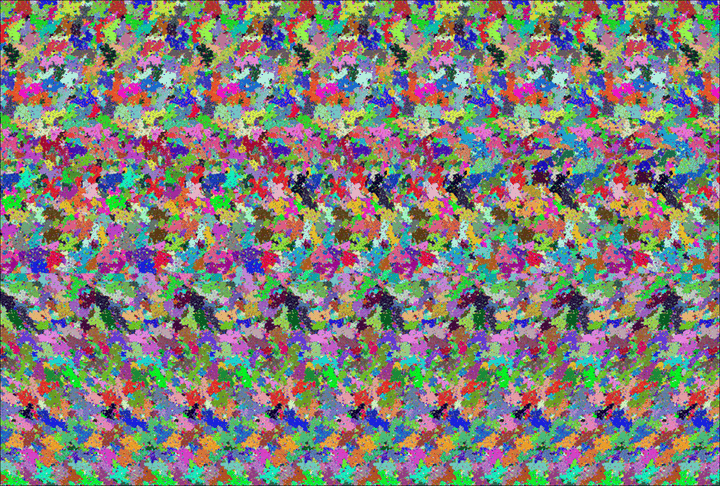
How old I was when I figured out the truth?: 11ish
In the intervening years, I didn't exactly stop thinking that I had a superpower; rather, I recognized that my superpower was so limited that it was functionally useless, and so I just sort of forgot about it. It wasn't until I was nearing tween-dom, when someone finally explained to me how binocular vision works, that I fully realized that I didn't have a superpower after all. (As you can imagine, it wasn't a huge loss.)
Scale of Embarrassment: 3 out of 10
I'm embarrassed that I wasn't more impressed with my own superpower when I thought I had one.
Wednesday, November 9, 2016
Recoil
When George W. Bush was re-elected in 2004, I was a month away from turning 17 years old and was settling into my junior year of high school. Like most teenagers not yet eligible to vote, I wasn't much interested in politics. I had a fuzzy sense that I agreed more with the Democrats than the Republicans, and that Bush had turned out to be something of a doofus as a president, but my political leanings ended there.
At 7:20 a.m. on the day after Election Day (which my computer's calendar function tells me was Wednesday, November 3, 2004), I walked into my first-period class, Drawing III. I sat at my drawing table and waited in anticipation for Suzie.
Suzie and I were both high-achieving SuperNerds who also really loved art classes. Semester after semester, Suzie and I ravenously and systematically took every art course our school offered: 2D and 3D Art, Drawing I-III, Painting I-II, Graphic Design I-II, AP Studio Art. We weren't friends outside of art class -- we probably could have been, but we moved in different circles and didn't feel the need to expand our social lives to include one another -- but we were steadfast art-class buddies, and over the course of four years we both came to love and look forward to the 40 minutes of every day that we would spend chatting over our canvases or charcoals.
Even though she was also a 16-year-old nonvoter in 2004, Suzie was extremely passionate about the election. (She was passionate in general about politics and government. For a painting class, she once produced a 24x36-inch oil painting depicting a caricature of Karl Rove controlling Bush with puppet strings.) Leading up to the presidential election, Suzie spent many art-class periods attempting to explain the issues to me and get me to care about them as much as she did. She regarded Bush as a war-mongering tyrant and Kerry as the great redeemer for a country going sorely awry. She would ask for my opinion on things like welfare and would correct me as I haplessly responded in vague generalities half-remembered from the news. I, meanwhile, regarded her zeal as a sort of charming personality flaw. I spent most of high school trying desperately not to take anything too seriously, and the gravity with which she took the election struck me as amusingly eccentric.
And so, on that Wednesday morning, knowing that Bush had defeated Kerry, I waited for Suzie's arrival. The morning prior, on Election Day, she had dressed in patriotic colors and insisted to me, in so many words, that the world would literally end if Bush was re-elected.
Just before the bell rang at 7:25, Suzie entered the studio, gathered her materials, and wordlessly took her seat at the drawing table facing mine. For several minutes, we both worked on our projects in silence. Every 30 seconds or so I would glance up in her direction, but Suzie kept her eyes on her paper. She knew that I was breathlessly waiting to hear what she would say on this, the day of Armageddon.
Finally, at around 7:32, Suzie set her pencil down with a snap and looked up. In a fierce and aggravated voice, she declared, "Bush won, but our country lost." For a moment, she glared at me in anger at the indignity of it all. Then the edge of her mouth flickered.
I burst out laughing.
At 7:20 a.m. on the day after Election Day (which my computer's calendar function tells me was Wednesday, November 3, 2004), I walked into my first-period class, Drawing III. I sat at my drawing table and waited in anticipation for Suzie.
Suzie and I were both high-achieving SuperNerds who also really loved art classes. Semester after semester, Suzie and I ravenously and systematically took every art course our school offered: 2D and 3D Art, Drawing I-III, Painting I-II, Graphic Design I-II, AP Studio Art. We weren't friends outside of art class -- we probably could have been, but we moved in different circles and didn't feel the need to expand our social lives to include one another -- but we were steadfast art-class buddies, and over the course of four years we both came to love and look forward to the 40 minutes of every day that we would spend chatting over our canvases or charcoals.
Even though she was also a 16-year-old nonvoter in 2004, Suzie was extremely passionate about the election. (She was passionate in general about politics and government. For a painting class, she once produced a 24x36-inch oil painting depicting a caricature of Karl Rove controlling Bush with puppet strings.) Leading up to the presidential election, Suzie spent many art-class periods attempting to explain the issues to me and get me to care about them as much as she did. She regarded Bush as a war-mongering tyrant and Kerry as the great redeemer for a country going sorely awry. She would ask for my opinion on things like welfare and would correct me as I haplessly responded in vague generalities half-remembered from the news. I, meanwhile, regarded her zeal as a sort of charming personality flaw. I spent most of high school trying desperately not to take anything too seriously, and the gravity with which she took the election struck me as amusingly eccentric.
And so, on that Wednesday morning, knowing that Bush had defeated Kerry, I waited for Suzie's arrival. The morning prior, on Election Day, she had dressed in patriotic colors and insisted to me, in so many words, that the world would literally end if Bush was re-elected.
Just before the bell rang at 7:25, Suzie entered the studio, gathered her materials, and wordlessly took her seat at the drawing table facing mine. For several minutes, we both worked on our projects in silence. Every 30 seconds or so I would glance up in her direction, but Suzie kept her eyes on her paper. She knew that I was breathlessly waiting to hear what she would say on this, the day of Armageddon.
Finally, at around 7:32, Suzie set her pencil down with a snap and looked up. In a fierce and aggravated voice, she declared, "Bush won, but our country lost." For a moment, she glared at me in anger at the indignity of it all. Then the edge of her mouth flickered.
I burst out laughing.
Friday, October 28, 2016
Something that I'd just know
In my dissertation, I spend a fair amount of time talking about the history of feminism, the politics of gender, and the way women's participation in society was constrained in general in the U.S. and in Britain, circa 1890 to 1935.
When I tell people this about my dissertation, they're usually not surprised (my feminism shows, maybe, more than I think it does), but it came as a bit of a surprise to me. Up until about a year and a half ago, I didn't know that my dissertation would involve these topics. My plan was to write about the history of physiological psychology as it pertains to Modernist literature. I won't bore you with the details of how or why my dissertation topic developed to include a focus on the women's movement, but suffice it to say, on or about March 2015, my day-to-day life suddenly included a bunch of reading about women's suffrage and related turn-of-the-century political rhetoric (and counter-rhetoric).
One novel I write about is The Judge. The book is by Rebecca West, who these days is known almost exclusively for writing a WWI novella called The Return of the Soldier, even though her literary career spanned from the 1910s to the 1980s. No one really reads The Judge, meaning that most people also wouldn't know that the novel isn't actually about professional judging, but instead follows the story of a young Scottish woman whose life basically falls to shambles because of her overbearing mother-in-law and emotionally volatile husband.
There's a passage early in the novel where our heroine, Ellen, spends the day roving around the idyllic Edinburgh countryside with her future husband, Yaverland. West has a knack for gorgeous scenic description, and she evokes a sense of graceful abandon as she describes "a wide moor of dark moss-hags, flung like a crumpled cloth on a slope that stretched as far as the eye could see to the base of blackhills about which clambered white mists." Ellen sprints through the fields, deer-like, for no other reason than the fact that the Pentlands are a landscape that demands joyous sprinting. As she runs, her legs jostle the items in her pockets, and they rattle noisily.
You don't often find girls or women running full-sprint in turn-of-the-century British literature. Literary women are more likely to be reposing creatures, sometimes walking but rarely running. If they're running, they're usually fleeing something in panic. The Judge seems to acknowledge this, as Yaverland, observing Ellen with some wonderment, remarks, "In a way, you're awfully like a boy."
This passage pops into my mind every now and then when I'm on the treadmill at the gym. There's a pretty significant gap between running gleefully through overcast Scottish moors and running for the sake of cardiovascular fitness on an indoor rubber loop, but that's kind of the point. It cheers me to picture myself not in a smelly gym, but in Ellen's place, under clouds with the "magnificent quality of mountains," ecstatic simply to have the opportunity to be outside and use her body in an athletic way.
And it cheers me to not be in Ellen's place. Unlike Ellen, I do not regard running as a rare treat that typically only boys get to enjoy. I do not have to run in skirts. Unlike Ellen, my freedom to run, at will and in shorts, is consistent with other freedoms. After Yaverland likens Ellen to a boy, she retorts, "I wish I was. But I'm a girl, and I've nothing before me." This crosses my mind while I'm on the treadmill, too.
Because I spend much of every day working on my dissertation, I'm frequently in this in-between mental space, swimming through the literature, politics, and culture of the 1910s as I go about my day in the 2010s. Mundane happenings or turns of phrase will resonate with things I've read in my research. Particularly when it comes to the opportunities available to women.
The 2016 election, I think, would have been meaningful to me regardless of my current job. But I'm glad my dissertation work is lining up the way it is.
When I tell people this about my dissertation, they're usually not surprised (my feminism shows, maybe, more than I think it does), but it came as a bit of a surprise to me. Up until about a year and a half ago, I didn't know that my dissertation would involve these topics. My plan was to write about the history of physiological psychology as it pertains to Modernist literature. I won't bore you with the details of how or why my dissertation topic developed to include a focus on the women's movement, but suffice it to say, on or about March 2015, my day-to-day life suddenly included a bunch of reading about women's suffrage and related turn-of-the-century political rhetoric (and counter-rhetoric).
One novel I write about is The Judge. The book is by Rebecca West, who these days is known almost exclusively for writing a WWI novella called The Return of the Soldier, even though her literary career spanned from the 1910s to the 1980s. No one really reads The Judge, meaning that most people also wouldn't know that the novel isn't actually about professional judging, but instead follows the story of a young Scottish woman whose life basically falls to shambles because of her overbearing mother-in-law and emotionally volatile husband.
There's a passage early in the novel where our heroine, Ellen, spends the day roving around the idyllic Edinburgh countryside with her future husband, Yaverland. West has a knack for gorgeous scenic description, and she evokes a sense of graceful abandon as she describes "a wide moor of dark moss-hags, flung like a crumpled cloth on a slope that stretched as far as the eye could see to the base of blackhills about which clambered white mists." Ellen sprints through the fields, deer-like, for no other reason than the fact that the Pentlands are a landscape that demands joyous sprinting. As she runs, her legs jostle the items in her pockets, and they rattle noisily.
You don't often find girls or women running full-sprint in turn-of-the-century British literature. Literary women are more likely to be reposing creatures, sometimes walking but rarely running. If they're running, they're usually fleeing something in panic. The Judge seems to acknowledge this, as Yaverland, observing Ellen with some wonderment, remarks, "In a way, you're awfully like a boy."
This passage pops into my mind every now and then when I'm on the treadmill at the gym. There's a pretty significant gap between running gleefully through overcast Scottish moors and running for the sake of cardiovascular fitness on an indoor rubber loop, but that's kind of the point. It cheers me to picture myself not in a smelly gym, but in Ellen's place, under clouds with the "magnificent quality of mountains," ecstatic simply to have the opportunity to be outside and use her body in an athletic way.
And it cheers me to not be in Ellen's place. Unlike Ellen, I do not regard running as a rare treat that typically only boys get to enjoy. I do not have to run in skirts. Unlike Ellen, my freedom to run, at will and in shorts, is consistent with other freedoms. After Yaverland likens Ellen to a boy, she retorts, "I wish I was. But I'm a girl, and I've nothing before me." This crosses my mind while I'm on the treadmill, too.
Because I spend much of every day working on my dissertation, I'm frequently in this in-between mental space, swimming through the literature, politics, and culture of the 1910s as I go about my day in the 2010s. Mundane happenings or turns of phrase will resonate with things I've read in my research. Particularly when it comes to the opportunities available to women.
The 2016 election, I think, would have been meaningful to me regardless of my current job. But I'm glad my dissertation work is lining up the way it is.
Friday, October 7, 2016
Can't you come back?
I graduated early from college, so I technically never had a second semester of my senior year. But because I can comfortably be classified as a SuperNerd, and because I was still living near campus and finishing my honors thesis, I decided to (possibly illegally?) audit a class during that otherwise empty semester.
The class was Literary Theory, and it had a reputation for being the most difficult English course at the college. The professor, WC, carried some of the blame for that, as he had his own reputation for having the highest standards of any faculty member of the department, but the course itself probably earned the rep on its own merits. "Literary Theory" is a blanket term that refers to all those abstruse "-isms" that critics use to talk about literature: historicism, Marxism, structuralism, poststructuralism, New Criticism, feminism, postcolonialism, etc. To study Literary Theory is to study how we choose to approach and interpret literature (as opposed to most English classes, which tend to just stick to doing the approaching and interpreting). In a Lit Theory class, you don't read novels. You read theoretical argy-bargy by people whose names have mega-currency in terms of intellectual name-dropability, like Saussure and Barthes and Cixous and Zizek.
For the final, WC told the class that we would have to write and defend our own theoretical guide to literary criticism. Which literary theory (or theories) would we subscribe to, and why? Cite examples. I didn't have to take the final (again, graduated), but I thought it was a fun assignment and decided to do it anyway (again, SuperNerd).
I began my essay as follows: "My theoretical guide to literary criticism is based on two core beliefs that I hold about literature. First, that literature is foundationally for the purpose of communication and understanding, meaning that writers, readers, and critics alike participate in 'literature' to gain increased knowledge, be it personal or cultural, of the human experience. Second is my belief that, put simply, the more information, the better."
I argued, basically, that if you want to claim that you really "know" what's going on in a book, you have to wring as much information out of that book as humanly possible. Be curious about implicit meaning and authorial intent. Be curious about the author's historical milieu and intellectual influences. Be curious about how the book interacts with your own assumptions and biases. Be curious about how brains work when encountering literature, in general. Not being curious about any of these things means that you're consciously depriving yourself of something that could make your understanding of the human experience more complete. (To be clear, this is a holistic philosophy of criticism. For casual/leisure readers, all bets are off.)
In his response to my final, WC teasingly called me a "theoretical omnivore." I've embraced that label ever since.
When cases like the recent "unmasking" of Elena Ferrante pop up, I follow them with interest, and they always prompt me to revisit my theoretical omnivorism. Here's a new twist on what it means to be an author, a reader, a critic. Do I still believe that the more information, the better?
I've never read any of Ferrante's books and have no familiarity with her at all beyond vague name recognition. Prior to the kerfuffle that hit the literary world this week, I didn't know that "Elena Ferrante" was a pseudonym, or that this fact was well-known and heartily appreciated by a large subset of her readers. I didn't know how widely beloved (and widely translated) her novels -- all originally written in Italian -- are. I'm still not totally clear on what Ferrante's reputation is within the creaky and nebulous "literary establishment," but given that the revelation of Ferrante's real-life identity made front page news on approximately a billion media platforms, I'm guessing she can be considered a literary heavyweight.
For those who haven't followed the story, in last Sunday's New York Review of Books, a reporter published a lengthy article making the case that he discovered Ferrante's real identity, based largely on an analysis of public income, tax, and property records. Following that announcement, there were two waves of response: First, an uproar of outrage and backlash against the reporter for "outing" Ferrante and not respecting her wish to remain anonymous. (An illustrative headline from The Washington Post: "The violation of Elena Ferrante." From NPR: "For Literary World, Unmasking Elena Ferrante Is Not a Scoop. It's a Disgrace.") After that, a bubbling up of articles attempting to explain all the outrage to a bemused larger public. (From the BBC: "Why is the exposure of Elena Ferrante causing such outrage?" From the Wall Street Journal: "Inside the Fallout Over Elena Ferrante's Identity")
I find the arguments in favor of outrage somewhat persuasive: I can see why a reader would find experiential value in having an author's identity shrouded in mystery. I can see why an author would prefer to remain anonymous, and why it might be in the best interest for the reading public to let him or her remain so (particularly if, as in the case of Ferrante, the author believes she might not be able to write non-anonymously). I can see the gendered overtones associated with anonymity and reveal (only in the modern era have women been able to stop using male pseudonyms to get their work taken seriously, and even then there's a gender gap associated with literary prestige). It doesn't help that the reporter responsible for the revelation, Claudio Gatti, seems like kind of a prick.
I also find the counterpoints (a.k.a. the "what's the big deal?" camp) somewhat persuasive. I can see how any attempt by an author (or reader) to control how a work is read or received is a naive exercise in futility, since texts gain their own life once introduced to the public. I can see how an author's identity, particularly for authors among the Literary Elite, is of significant academic interest -- George Eliot/Mary Ann Evans is an interesting comparison study. I can see how the "gendered overtones" argument is uneasily applied here, since in this case, a female writer chose a female pseudonym.
Ultimately, in this case, I find that I'm still a theoretical omnivore. I can't help but welcome more information. What I know about reading and literary study has me believing that knowing this information will only, in the end, benefit both readers and the criticism of her work.
What I find curious is that I believe my stance is in the minority. In addition to the considerable backlash to Gatti's story, the Times Literary Supplement, the standard-bearer of contemporary literary opinion, argued that knowing Ferrante's true identity doesn't do anyone any good, and that, put in NYTRoB's shoes, they would have told Gatti to hit the bricks.
While I'm loath to disagree with the eminent TLS, I raise my eyebrow at this justification for outrage: "Most offensive about Gatti’s revelations are not his disregard of an author’s right to privacy or his failure to appreciate that literary anonymity is an art and not a crime, but his lumpen literalism, his misreading of the rules, his catastrophic misunderstanding of what criticism is or how reading actually works. He thinks he has put us out of our misery, but no one really wanted to know the identity of Elena Ferrante. It was a puzzle we enjoyed, and now Gatti has waded in and spoilt the game."
I refuse to believe that the pleasure of reading is so cobweb-delicate, and the practice of literary criticism so tenuous, that it can be ruined by a bit of factual knowledge. Gatti may have "spoilt" one game, but I like to think that when one game box closes, another one opens.
The class was Literary Theory, and it had a reputation for being the most difficult English course at the college. The professor, WC, carried some of the blame for that, as he had his own reputation for having the highest standards of any faculty member of the department, but the course itself probably earned the rep on its own merits. "Literary Theory" is a blanket term that refers to all those abstruse "-isms" that critics use to talk about literature: historicism, Marxism, structuralism, poststructuralism, New Criticism, feminism, postcolonialism, etc. To study Literary Theory is to study how we choose to approach and interpret literature (as opposed to most English classes, which tend to just stick to doing the approaching and interpreting). In a Lit Theory class, you don't read novels. You read theoretical argy-bargy by people whose names have mega-currency in terms of intellectual name-dropability, like Saussure and Barthes and Cixous and Zizek.
For the final, WC told the class that we would have to write and defend our own theoretical guide to literary criticism. Which literary theory (or theories) would we subscribe to, and why? Cite examples. I didn't have to take the final (again, graduated), but I thought it was a fun assignment and decided to do it anyway (again, SuperNerd).
I began my essay as follows: "My theoretical guide to literary criticism is based on two core beliefs that I hold about literature. First, that literature is foundationally for the purpose of communication and understanding, meaning that writers, readers, and critics alike participate in 'literature' to gain increased knowledge, be it personal or cultural, of the human experience. Second is my belief that, put simply, the more information, the better."
I argued, basically, that if you want to claim that you really "know" what's going on in a book, you have to wring as much information out of that book as humanly possible. Be curious about implicit meaning and authorial intent. Be curious about the author's historical milieu and intellectual influences. Be curious about how the book interacts with your own assumptions and biases. Be curious about how brains work when encountering literature, in general. Not being curious about any of these things means that you're consciously depriving yourself of something that could make your understanding of the human experience more complete. (To be clear, this is a holistic philosophy of criticism. For casual/leisure readers, all bets are off.)
In his response to my final, WC teasingly called me a "theoretical omnivore." I've embraced that label ever since.
When cases like the recent "unmasking" of Elena Ferrante pop up, I follow them with interest, and they always prompt me to revisit my theoretical omnivorism. Here's a new twist on what it means to be an author, a reader, a critic. Do I still believe that the more information, the better?
I've never read any of Ferrante's books and have no familiarity with her at all beyond vague name recognition. Prior to the kerfuffle that hit the literary world this week, I didn't know that "Elena Ferrante" was a pseudonym, or that this fact was well-known and heartily appreciated by a large subset of her readers. I didn't know how widely beloved (and widely translated) her novels -- all originally written in Italian -- are. I'm still not totally clear on what Ferrante's reputation is within the creaky and nebulous "literary establishment," but given that the revelation of Ferrante's real-life identity made front page news on approximately a billion media platforms, I'm guessing she can be considered a literary heavyweight.
For those who haven't followed the story, in last Sunday's New York Review of Books, a reporter published a lengthy article making the case that he discovered Ferrante's real identity, based largely on an analysis of public income, tax, and property records. Following that announcement, there were two waves of response: First, an uproar of outrage and backlash against the reporter for "outing" Ferrante and not respecting her wish to remain anonymous. (An illustrative headline from The Washington Post: "The violation of Elena Ferrante." From NPR: "For Literary World, Unmasking Elena Ferrante Is Not a Scoop. It's a Disgrace.") After that, a bubbling up of articles attempting to explain all the outrage to a bemused larger public. (From the BBC: "Why is the exposure of Elena Ferrante causing such outrage?" From the Wall Street Journal: "Inside the Fallout Over Elena Ferrante's Identity")
I find the arguments in favor of outrage somewhat persuasive: I can see why a reader would find experiential value in having an author's identity shrouded in mystery. I can see why an author would prefer to remain anonymous, and why it might be in the best interest for the reading public to let him or her remain so (particularly if, as in the case of Ferrante, the author believes she might not be able to write non-anonymously). I can see the gendered overtones associated with anonymity and reveal (only in the modern era have women been able to stop using male pseudonyms to get their work taken seriously, and even then there's a gender gap associated with literary prestige). It doesn't help that the reporter responsible for the revelation, Claudio Gatti, seems like kind of a prick.
I also find the counterpoints (a.k.a. the "what's the big deal?" camp) somewhat persuasive. I can see how any attempt by an author (or reader) to control how a work is read or received is a naive exercise in futility, since texts gain their own life once introduced to the public. I can see how an author's identity, particularly for authors among the Literary Elite, is of significant academic interest -- George Eliot/Mary Ann Evans is an interesting comparison study. I can see how the "gendered overtones" argument is uneasily applied here, since in this case, a female writer chose a female pseudonym.
Ultimately, in this case, I find that I'm still a theoretical omnivore. I can't help but welcome more information. What I know about reading and literary study has me believing that knowing this information will only, in the end, benefit both readers and the criticism of her work.
What I find curious is that I believe my stance is in the minority. In addition to the considerable backlash to Gatti's story, the Times Literary Supplement, the standard-bearer of contemporary literary opinion, argued that knowing Ferrante's true identity doesn't do anyone any good, and that, put in NYTRoB's shoes, they would have told Gatti to hit the bricks.
While I'm loath to disagree with the eminent TLS, I raise my eyebrow at this justification for outrage: "Most offensive about Gatti’s revelations are not his disregard of an author’s right to privacy or his failure to appreciate that literary anonymity is an art and not a crime, but his lumpen literalism, his misreading of the rules, his catastrophic misunderstanding of what criticism is or how reading actually works. He thinks he has put us out of our misery, but no one really wanted to know the identity of Elena Ferrante. It was a puzzle we enjoyed, and now Gatti has waded in and spoilt the game."
I refuse to believe that the pleasure of reading is so cobweb-delicate, and the practice of literary criticism so tenuous, that it can be ruined by a bit of factual knowledge. Gatti may have "spoilt" one game, but I like to think that when one game box closes, another one opens.
Wednesday, July 20, 2016
The thing with feathers
Last week, for the second time in as many years, our small community of doctoral students at BC suffered a loss. Kiara had been fighting breast cancer for six years, but, as I learned via Facebook from her family, had spent the last four months in hospice, and she passed last Wednesday.
I didn't know Kiara well, and as such (and as with Ben), writing about her publicly to ruminate on her life and passing doesn't feel very comfortable. At the same time, my sense of public decorum doesn't govern my thoughts, and despite our non-closeness, for the past few years I often found myself thinking about Kiara as I've plodded along in my track towards a PhD.
She was a few years ahead of me in the grad program (or maybe just two? those lines start to blur after the first couple of years), and her terminal diagnosis -- which came after a period of remission -- occurred during the spring of my second year, when I was still taking classes. For her, the news came while she was beginning the last leg of her life as a PhD student, just as she was plunging headfirst into dissertation writing.
Now that I'm at the dissertation-writing stage myself, I understand it to be the most psychically taxing part of earning a PhD. It's not necessarily the most hectic period, but it's the part where you cease to have much, if any, outside support or structure. The pressure to keep charging on, to force yourself to keep working when the project feels daunting and unclear and you feel unqualified and unmotivated, can wear you down. Adding a terminal cancer diagnosis to all that has always sounded impossible to me. But Kiara did it. She defended her dissertation last November.
Kiara found public writing, including blogging, to be a useful way to process her diagnosis, prognosis, and path ahead. It's thanks to her public writing that I know she had a complicated relationship with the dominant cultural narratives used to discuss cancer and people battling the disease. Kiara pragmatically tolerated the "glamorization" of cancer in TV and films. ("If putting illness in the spotlight raises even $5," she wrote in the fall of 2014, "bring on the bald caps and heavy-handed cigarette metaphors.") But she was impatient with platitudes ("It'll be okay!" or "You're so brave!") and would get annoyed with the expectations of wisdom or stoicism placed on cancer patients. She was an unflagging advocate of honesty. In her blog, she pondered how best to respond when people ask how they can support someone coping with a terminal illness. Her recommendation: "Treat them like normal, except for when they need to be a cancer patient. Then, let them be a cancer patient, and remove all obstacles to that reality."
I wasn't part of Kiara's support system and thus didn't directly confront the complicated task of being a Good Friend to Someone with Terminal Cancer. From a distance, though, I still find myself engaging with the issues she addresses in her blog, particularly the way cancer patients are totemized into walking life lessons for the non-sick. I've found myself guilty of mentally using Kiara as a sort of inspiration or motivation tool. When I feel overwhelmed with work or am having trouble working up the enthusiasm to write, I think, "Kiara managed to do this while undergoing treatment for brain tumors," and it helps to put things in perspective.
I also occasionally find myself wondering what I would've done in her position. If I had learned last year that I was facing, generously, three to five more years of life, would I have decided to try to finish the PhD, or would I have quit and opted to dedicate my time elsewhere? Kiara's situation gave a normally hypothetical scenario an unusual jolt of reality. Why am I pursuing a PhD? Why was Kiara? How, if at all, did her diagnosis help clarify this question? What might it clarify for me?
I'm not really sure what Kiara would have to say about my brain's eagerness to use her own very real, very devastating personal situation for the selfish purposes of motivation and thought experiments. It's a natural enough thing for me to do, but there's also a degree of callousness that comes with abstracting and internalizing someone else's experience. Does the naturalness and utility of self-involved thinking undermine efforts to treat others as empathetically as possible?
Not knowing her very well, I can't say how Kiara would have responded. All I can say is that, knowing about her passion for honesty and critical thinking, and her own gift for deep and thoughtful empathy, I have to assume she'd advocate my asking, and continuing to ask, these kinds of questions.
I didn't know Kiara well, and as such (and as with Ben), writing about her publicly to ruminate on her life and passing doesn't feel very comfortable. At the same time, my sense of public decorum doesn't govern my thoughts, and despite our non-closeness, for the past few years I often found myself thinking about Kiara as I've plodded along in my track towards a PhD.
She was a few years ahead of me in the grad program (or maybe just two? those lines start to blur after the first couple of years), and her terminal diagnosis -- which came after a period of remission -- occurred during the spring of my second year, when I was still taking classes. For her, the news came while she was beginning the last leg of her life as a PhD student, just as she was plunging headfirst into dissertation writing.
Now that I'm at the dissertation-writing stage myself, I understand it to be the most psychically taxing part of earning a PhD. It's not necessarily the most hectic period, but it's the part where you cease to have much, if any, outside support or structure. The pressure to keep charging on, to force yourself to keep working when the project feels daunting and unclear and you feel unqualified and unmotivated, can wear you down. Adding a terminal cancer diagnosis to all that has always sounded impossible to me. But Kiara did it. She defended her dissertation last November.
Kiara found public writing, including blogging, to be a useful way to process her diagnosis, prognosis, and path ahead. It's thanks to her public writing that I know she had a complicated relationship with the dominant cultural narratives used to discuss cancer and people battling the disease. Kiara pragmatically tolerated the "glamorization" of cancer in TV and films. ("If putting illness in the spotlight raises even $5," she wrote in the fall of 2014, "bring on the bald caps and heavy-handed cigarette metaphors.") But she was impatient with platitudes ("It'll be okay!" or "You're so brave!") and would get annoyed with the expectations of wisdom or stoicism placed on cancer patients. She was an unflagging advocate of honesty. In her blog, she pondered how best to respond when people ask how they can support someone coping with a terminal illness. Her recommendation: "Treat them like normal, except for when they need to be a cancer patient. Then, let them be a cancer patient, and remove all obstacles to that reality."
I wasn't part of Kiara's support system and thus didn't directly confront the complicated task of being a Good Friend to Someone with Terminal Cancer. From a distance, though, I still find myself engaging with the issues she addresses in her blog, particularly the way cancer patients are totemized into walking life lessons for the non-sick. I've found myself guilty of mentally using Kiara as a sort of inspiration or motivation tool. When I feel overwhelmed with work or am having trouble working up the enthusiasm to write, I think, "Kiara managed to do this while undergoing treatment for brain tumors," and it helps to put things in perspective.
I also occasionally find myself wondering what I would've done in her position. If I had learned last year that I was facing, generously, three to five more years of life, would I have decided to try to finish the PhD, or would I have quit and opted to dedicate my time elsewhere? Kiara's situation gave a normally hypothetical scenario an unusual jolt of reality. Why am I pursuing a PhD? Why was Kiara? How, if at all, did her diagnosis help clarify this question? What might it clarify for me?
I'm not really sure what Kiara would have to say about my brain's eagerness to use her own very real, very devastating personal situation for the selfish purposes of motivation and thought experiments. It's a natural enough thing for me to do, but there's also a degree of callousness that comes with abstracting and internalizing someone else's experience. Does the naturalness and utility of self-involved thinking undermine efforts to treat others as empathetically as possible?
Not knowing her very well, I can't say how Kiara would have responded. All I can say is that, knowing about her passion for honesty and critical thinking, and her own gift for deep and thoughtful empathy, I have to assume she'd advocate my asking, and continuing to ask, these kinds of questions.
Saturday, February 20, 2016
To go over everything
After having been forgotten by the world for a number of years in the late 2000s, Internet quizzes have made a comeback, and are more or less constantly being circulated around Facebook. The general pattern is this: For about a week at a time, a dozen or more of your Facebook friends will suddenly post a stream of mostly identical quiz results, announcing that they're INFJ, or that they've been sorted into Hufflepuff, or that "y'all" is their most-used word on Facebook, or that they side 95% with Bernie and 98% with Hillary. Sometimes the results are the product of an actual, more or less rigorous quiz or survey; sometimes they're the product of an algorithm that spits out factoids about your friends or Facebook profile in exchange for your willingness to give an anonymous company access to your personal data.
A few months ago, the Quiz du Jour was something called "Can We Guess Your Level of Education?" Depending on the version you took, this quiz asked a series of 15-25 questions that test basic factual knowledge (What is H2O? Where is the Sahara Desert? Which Shakespeare play features Ophelia? What travels faster, light waves or sound waves? Who wrote Mein Kampf?). Do poorly and the quiz guesses you're a high school dropout. Do well and the quiz guesses you have a PhD.
It's a nakedly asinine quiz, easy enough that anyone with halfway decent retention from high school is guaranteed a result of "Master's degree" or higher. The transparent flattery of the exercise is, I assume, the point -- all of my Facebook friends who posted their results seemed charmed (in a fittingly tongue-and-cheek way) to have fooled a dumb quiz into thinking they have a PhD. But who cares? What's the harm of a fun diversion that comes with a silly ego boost? In any case, the quiz legitimately proves you're capable of dredging up trivia from your 10th grade geography class.
As someone pursuing a PhD, I appreciated the silliness, but I couldn't help stewing a bit over the irony of the quiz format. The quiz rewards people for correctly answering a variety of multiple-choice recognition problems covering a wide number of subjects, from math to history to literature. This is almost the literal antithesis to what it means to have a PhD, a process that requires you to spend several years pretending that nothing in the universe exists outside of your very specialized field of study. Now that I'm getting my doctorate in English literature, it really doesn't matter in the slightest if I no longer remember that Fe is the symbol for iron on the periodic table, but it's very important that I know the difference between the Vorticists and Bloomsbury modernists. Someone with a PhD in chemistry can still become a Nobel Laureate in their field even if an errant stroke were to make them forget they ever read a word of Shakespeare. If we want to be real about it, a proper "Can We Guess if You Have a PhD?" quiz would ask questions like, "Have you ever gotten into an intense and involved argument about citation style?" and "How many days are you willing to go without seeing or talking to anyone?"
I've mentioned this before, but as I've gotten older, my internal sense of what it means to be intelligent has both shifted and broadened, as has my understanding of what it means to be "educated" and what accredited degree programs actually signify. A PhD, like any other type of certification, is a means to a certain array of ends, one that proves that you're persistent and organized enough to investigate a single subject to exhaustive lengths. It's not likely you'll get a PhD without being intelligent, but a grand majority of intelligent people don't have PhDs, because most people don't need advanced degrees to achieve their goals.
I've been in my PhD program for about five years now, and off and on throughout those five years I've asked myself why I'm doing it. There are a hundred ways of answering that question that would be more or less truthful, but I've only ever been able to come up with one consistent, honest, and satisfying answer: I'm getting a PhD so that I'll have a PhD. I want to prove that I can do it. That's my goal, and I need a PhD to reach it, so here I am.
A few months ago, the Quiz du Jour was something called "Can We Guess Your Level of Education?" Depending on the version you took, this quiz asked a series of 15-25 questions that test basic factual knowledge (What is H2O? Where is the Sahara Desert? Which Shakespeare play features Ophelia? What travels faster, light waves or sound waves? Who wrote Mein Kampf?). Do poorly and the quiz guesses you're a high school dropout. Do well and the quiz guesses you have a PhD.
It's a nakedly asinine quiz, easy enough that anyone with halfway decent retention from high school is guaranteed a result of "Master's degree" or higher. The transparent flattery of the exercise is, I assume, the point -- all of my Facebook friends who posted their results seemed charmed (in a fittingly tongue-and-cheek way) to have fooled a dumb quiz into thinking they have a PhD. But who cares? What's the harm of a fun diversion that comes with a silly ego boost? In any case, the quiz legitimately proves you're capable of dredging up trivia from your 10th grade geography class.
As someone pursuing a PhD, I appreciated the silliness, but I couldn't help stewing a bit over the irony of the quiz format. The quiz rewards people for correctly answering a variety of multiple-choice recognition problems covering a wide number of subjects, from math to history to literature. This is almost the literal antithesis to what it means to have a PhD, a process that requires you to spend several years pretending that nothing in the universe exists outside of your very specialized field of study. Now that I'm getting my doctorate in English literature, it really doesn't matter in the slightest if I no longer remember that Fe is the symbol for iron on the periodic table, but it's very important that I know the difference between the Vorticists and Bloomsbury modernists. Someone with a PhD in chemistry can still become a Nobel Laureate in their field even if an errant stroke were to make them forget they ever read a word of Shakespeare. If we want to be real about it, a proper "Can We Guess if You Have a PhD?" quiz would ask questions like, "Have you ever gotten into an intense and involved argument about citation style?" and "How many days are you willing to go without seeing or talking to anyone?"
I've mentioned this before, but as I've gotten older, my internal sense of what it means to be intelligent has both shifted and broadened, as has my understanding of what it means to be "educated" and what accredited degree programs actually signify. A PhD, like any other type of certification, is a means to a certain array of ends, one that proves that you're persistent and organized enough to investigate a single subject to exhaustive lengths. It's not likely you'll get a PhD without being intelligent, but a grand majority of intelligent people don't have PhDs, because most people don't need advanced degrees to achieve their goals.
I've been in my PhD program for about five years now, and off and on throughout those five years I've asked myself why I'm doing it. There are a hundred ways of answering that question that would be more or less truthful, but I've only ever been able to come up with one consistent, honest, and satisfying answer: I'm getting a PhD so that I'll have a PhD. I want to prove that I can do it. That's my goal, and I need a PhD to reach it, so here I am.
Saturday, January 16, 2016
It's been a long day without you, my friend
I've been awfully negligent of this here blog. Prior to the bone-dry drought of the past several months, since I began the blog at the age of 16, I'd never gone longer than two months without posting.
I could give a few different convincing-sounding reasons for my withdrawal, one of which I discussed in my last post, all the way back in April. Busyness is also a reason though not a good excuse, as I was demonstrably busier, for example, during my junior year of college. The single most prominent and pertinent reason I haven't been writing is that I've come to something of a crossroads when it comes to my attitude towards blogging. I've historically used this blog to write about topics more or less in the abstract: I write what I think about aging, or caffeine, or travel, or friendship, or holidays, or teaching, or feminism. I was bolder about my opinions when I was a teenager, and more inclined to spout off whatever was on my mind about a given topic, inwardly confident that what I wrote was clever and worth reading. I've shed a lot of that boldness (call it confidence, call it narcissism) over the years. I've developed a stronger and stronger internal voice that says, "What do you really have to say? Is it really worth the time, yours or anyone else's?" Any given topic has likely been written about more thoroughly, more poignantly, and with more wisdom by someone else.
The cold reality is that what I have to say has never been that important. What makes my blog interesting (if it is interesting) is what makes any personal blog interesting (if they are interesting), which is that they're personal. My blog is, first and foremost, a record of me and of how my brain is operating at any given moment. What I write about is secondary to the attitude, style, and manner in which I write. Wikipedia (or actual encyclopedias) exist for the times when we want to learn something.
This is an obvious but oddly difficult pill for me to swallow. Basically, I either need to give up blogging entirely or admit that it's acceptable to use this blog to bask in the mundane and the personal, trusting that the outcome will continue to be a record that I'll find interesting to revisit later in life.
I'm going to try to do a better job of pursuing the latter path in 2016. Let's start (belatedly) with my annual New Years post.
----
Predictions of Varying Certainty for 2015:
- For the first time, I will sign up for and run a 5K or 10K race. I'll find it fun but not worth doing on the regular.
- At least one close friend will have a baby. I will hold that baby.
- GR and I will plan our wedding, and in defiance of everyone who insists otherwise, we will find the process to be relatively simple and stress-free.
- I will write at least one chapter of my dissertation.
- I will seriously entertain the idea of visiting the British Isles but will ultimately defer my trip to 2016 and not leave the country at all.
- I will attend at least one concert and/or theatrical performance.
- At least five close friends/family members will come visit me and GR in Boston.
How prescient I actually was:
- Failure. I came very close to signing up for a race here and there, and if I'd spent Thanksgiving in Naperville I'd almost certainly have done the local Turkey Trot. But alas.
- UGH, YOU GUYS. I KNOW, OKAY? I still haven't held a baby.
- A successful one! Our wedding was a couple weeks ago (more on that, probably, in a future post) and both the planning and the wedding itself were joyful and not really very stressful at all.
- Success! The chapter has yet to be vetted/officially approved by my whole committee, but I have one written!
- This is partially true, in that I didn't leave the country in 2015, but I also didn't really seriously entertain the idea of going to the British Isles this year, either.
- Both! Mid-year, GR and I went to an Ani DiFranco concert, fulfilling one of my lifelong dreams, and around Christmas we went with his family to see the Lion King on Broadway in Chicago. My Boston friends also took me to see a band called Sister Sparrow and the Dirty Birds as a bachelorette outing in December.
- Success with a vengeance! We got Hanzel and Emily and Chambers and Megan and Cathi and Alex and my mom and basically GR's entire immediate family and overall this was a real fruitful year for visiting.
Predictions of Varying Certainty for 2016:
- I'll get married to GR and we'll go on a super fun honeymoon to Puerto Rico.
- I WILL HOLD A BABY OR SO HELP ME GOD. The first baby I ever hold will be Megan's baby, and it will be glorious and I won't drop her. Even further, I'll get to hold more than one baby this year.
- I will go on a run that is over eight miles long (acknowledging that my longest run to date is six miles).
- I will sustain an injury of some sort which sends me to the ER, such as a minor break or stitches. (I don't hope this happens, but I sort of feel like I'm due, given my klutziness.)
- I will publish an article in an academic journal and present at least one conference.
- I will participate in a sport, game, and/or leisure activity I've never tried before (e.g., snowboarding, shuffleboard, Settlers of Catan).
- GR and I will visit New York City.
I could give a few different convincing-sounding reasons for my withdrawal, one of which I discussed in my last post, all the way back in April. Busyness is also a reason though not a good excuse, as I was demonstrably busier, for example, during my junior year of college. The single most prominent and pertinent reason I haven't been writing is that I've come to something of a crossroads when it comes to my attitude towards blogging. I've historically used this blog to write about topics more or less in the abstract: I write what I think about aging, or caffeine, or travel, or friendship, or holidays, or teaching, or feminism. I was bolder about my opinions when I was a teenager, and more inclined to spout off whatever was on my mind about a given topic, inwardly confident that what I wrote was clever and worth reading. I've shed a lot of that boldness (call it confidence, call it narcissism) over the years. I've developed a stronger and stronger internal voice that says, "What do you really have to say? Is it really worth the time, yours or anyone else's?" Any given topic has likely been written about more thoroughly, more poignantly, and with more wisdom by someone else.
The cold reality is that what I have to say has never been that important. What makes my blog interesting (if it is interesting) is what makes any personal blog interesting (if they are interesting), which is that they're personal. My blog is, first and foremost, a record of me and of how my brain is operating at any given moment. What I write about is secondary to the attitude, style, and manner in which I write. Wikipedia (or actual encyclopedias) exist for the times when we want to learn something.
This is an obvious but oddly difficult pill for me to swallow. Basically, I either need to give up blogging entirely or admit that it's acceptable to use this blog to bask in the mundane and the personal, trusting that the outcome will continue to be a record that I'll find interesting to revisit later in life.
I'm going to try to do a better job of pursuing the latter path in 2016. Let's start (belatedly) with my annual New Years post.
----
Predictions of Varying Certainty for 2015:
- For the first time, I will sign up for and run a 5K or 10K race. I'll find it fun but not worth doing on the regular.
- At least one close friend will have a baby. I will hold that baby.
- GR and I will plan our wedding, and in defiance of everyone who insists otherwise, we will find the process to be relatively simple and stress-free.
- I will write at least one chapter of my dissertation.
- I will seriously entertain the idea of visiting the British Isles but will ultimately defer my trip to 2016 and not leave the country at all.
- I will attend at least one concert and/or theatrical performance.
- At least five close friends/family members will come visit me and GR in Boston.
How prescient I actually was:
- Failure. I came very close to signing up for a race here and there, and if I'd spent Thanksgiving in Naperville I'd almost certainly have done the local Turkey Trot. But alas.
- UGH, YOU GUYS. I KNOW, OKAY? I still haven't held a baby.
- A successful one! Our wedding was a couple weeks ago (more on that, probably, in a future post) and both the planning and the wedding itself were joyful and not really very stressful at all.
- Success! The chapter has yet to be vetted/officially approved by my whole committee, but I have one written!
- This is partially true, in that I didn't leave the country in 2015, but I also didn't really seriously entertain the idea of going to the British Isles this year, either.
- Both! Mid-year, GR and I went to an Ani DiFranco concert, fulfilling one of my lifelong dreams, and around Christmas we went with his family to see the Lion King on Broadway in Chicago. My Boston friends also took me to see a band called Sister Sparrow and the Dirty Birds as a bachelorette outing in December.
- Success with a vengeance! We got Hanzel and Emily and Chambers and Megan and Cathi and Alex and my mom and basically GR's entire immediate family and overall this was a real fruitful year for visiting.
Predictions of Varying Certainty for 2016:
- I'll get married to GR and we'll go on a super fun honeymoon to Puerto Rico.
- I WILL HOLD A BABY OR SO HELP ME GOD. The first baby I ever hold will be Megan's baby, and it will be glorious and I won't drop her. Even further, I'll get to hold more than one baby this year.
- I will go on a run that is over eight miles long (acknowledging that my longest run to date is six miles).
- I will sustain an injury of some sort which sends me to the ER, such as a minor break or stitches. (I don't hope this happens, but I sort of feel like I'm due, given my klutziness.)
- I will publish an article in an academic journal and present at least one conference.
- I will participate in a sport, game, and/or leisure activity I've never tried before (e.g., snowboarding, shuffleboard, Settlers of Catan).
- GR and I will visit New York City.
Subscribe to:
Posts (Atom)