On Having Your Professional Future Be a Question Mark
The earliest recorded instance of me using this blog to hem and haw about getting a PhD, like some kind of Nerd Hamlet, is April 6, 2010. In that post, you can see me wrangling with the core issues: What's my motivation for doing this? Is it because I want to be a professor? (I do want to be a professor, I think.) The job market is already bad; what happens if I finish only to discover that the world has stopped hiring English professors altogether?
Pursuing the degree itself never seemed too daunting or risky. (Like, it didn't seem easy, but I anticipated feeling at home in grad school.) What was daunting was the question of what, if anything, I'd be able to do once the degree was in hand.
. . .
The employment problem in academia (by which I really mean the Humanities) is often framed as a simple supply vs. demand issue: there's a glut of PhDs looking for professor jobs and not enough professor jobs to go around. It's a valid interpretation of the situation, and it's also not a predicament unique to the Ivory Tower. The same can be said of many industries in our weird post-recession world. A violin, played by an out-of-work violinist, wails for all of us.
But... why aren't there enough professor jobs? For millennials graduating high school, college has become a hotter destination than Coachella. The NCES reports that enrollment in higher ed increased by 21% between 1994 and 2004, and then another 17% between 2004 and 2014. If the demand for undergraduate educations is steadily increasing, shouldn't this create a corresponding increase in demand for professors? Why are the number of job openings declining instead?
Without getting mired in the weeds of a complicated topic, I'd like to answer this question by focusing on what insider-types call the adjunct crisis. When we talk about "professors," we're typically talking about nerds with tenured professorships: the eccentric, elbow-patched wizards who haunt the same campuses for decades. Adjuncts are a different breed. They're mercenary professors, part-time faculty hired to teach on a class-by-class basis. They're academia's temps. And, as is typical with temp work, the compensation is usually embarrassing (~$3,000 per course, or ~$20,000 per year) and the roles offer neither benefits nor job security.
As this Forbes article points out, despite the rise in student enrollment and simultaneous skyrocketing of tuition costs, more and more colleges are substituting tenured professor positions for cheap adjunct labor: "In 1975, 30 percent of college faculty were part-time. By 2011, 51 percent of college faculty were part-time, and another 19 percent were non–tenure track, full-time employees." Along similar lines, an AAUP study reported that between 1975 and 2014, the percentage of college instructors who were tenure or tenure-track decreased from 45% to 29%, while part-time adjuncts increased from 24% to 41%. When I say that the number of job openings for Humanities PhDs is declining, I'm specifically talking about the scarcity of tenure-track positions (i.e., the ones that PhDs actually want).
Bottom line: there are actually plenty of teaching jobs to go around for Humanities PhDs. But they're mostly temp jobs. If you try to make your living off of them, you need to make peace with subsisting on government cheese and never truly figuring out what a 401K is.
And, as you might expect, when old-school wizardy professor jobs do become available, they're extremely competitive, with hundreds of qualified applicants vying for each posting. As of a few decades ago, in the Humanities, there was relatively little pressure to publish articles or books while in graduate school. Now, everyone is using publishing credentials as a quick way to sort through the massive stack of resumes. A liberal arts college in rural Kansas will barely glance at your application unless you have a dozen conference appearances and three publications on record, and preferably a book deal in hand, upon graduation.
So, here's the new conventional wisdom for what you can expect after your doctoral graduation: Having attained your degree, you slum it in adjunctland for a while, pinching pennies and doing what you can while you make your resume more desirable. Every year, for an undetermined number of years, you apply for those coveted tenure-track jobs (wherever they may be). You live in hope that the adjunct crisis will be solved, that universities will start investing in full professorships again and the market will turn around. That doesn't happen, but one winter, the stars finally align in your favor. Off to Kansas you go, to embark on the seven-year journey to achieve tenure.
Or, maybe the stars don't align, and it's... adjunctland forever, I guess?
. . .
Jeez, you might be thinking, if academia is basically a real-life Sarlacc pit for unwitting Humanities PhDs, why did you bother?
This gets at the heart of what I was grappling with in 2010. I knew all the Bad News, but I came to the conclusion that getting a PhD would be worth it to me even if I never actually got to live out my dream of professional professor-ing. I landed on what I called a "passable middle ground": I reasoned that "if I get accepted into any of the high-profile PhD programs to which I apply, I'll spend the next 5-8 years getting paid to do something I love, and if I come out the other end finding that I can't find a job, well, at least then I'll have a PhD."
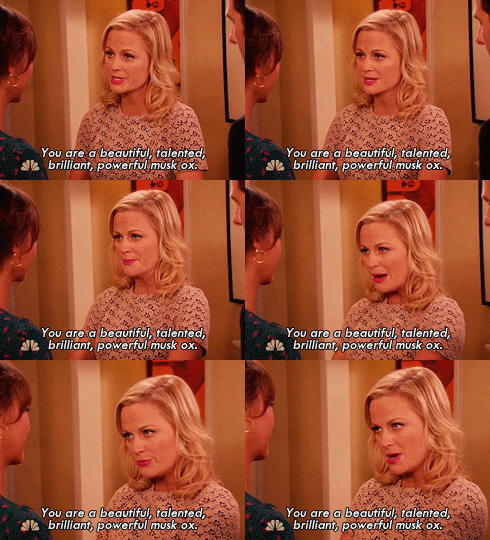
Okay, cool, in that case... why did you just lecture me about adjunct labor? Why rehash what you already know? Just keep on doing your thing, you beautiful, talented, brilliant, powerful musk-ox!
Frankly, I just kind of felt like I needed to lay the situation out there, one more time, as explicitly as possible. I'd like to be a professor -- a real, wizard-type professor -- provided that the right fit comes along. I loved graduate school and I love teaching college-level literature. Right now, fresh off my graduation, I'm trying my hardest to see if I can make that future work for me.
But now, fresh off my graduation, is also when I'm starting to plan for the alternate timeline: The timeline where I discover that staying in academia doesn't justify the necessary sacrifices of time or effort or putting other things on hold, and so I opt to pursue a different path. There are other things I could do that would make me happy.
When I tell my friends and family about that alternate timeline, I see them becoming sad for me. I see them beginning to form the requisite encouragements, the things you say to disappointed loved ones. ("You're so smart! The right opportunity is out there! Any college would be lucky to have you! Have you thought about sending your resume to Northwestern?") They think I'm being unreasonably pessimistic, or that I lack confidence or grit or sticktoitiveness, or, maybe, that I'm being artificially self-deprecating.
What I need everyone to know is that this was always the plan. The plan was to get a PhD and then smilingly face the unknown. I encourage you to join me in welcoming it.

No comments:
Post a Comment